
MiMic
Innovation Lab
Advancing microfluidic technologies and organ-on-chip systems for the future of biomedical research at Politecnico di Milano
About Our Lab
The MiMic Lab at the Department of Electronics, Information and Bioengineering (DEIB) of Politecnico di Milano focuses on developing cutting-edge microfluidic technologies and organ-on-chip systems.
Our interdisciplinary team combines expertise in bioengineering, microfabrication, and cell biology to create innovative platforms for drug discovery, disease modeling, and personalized medicine.
Meet Our Team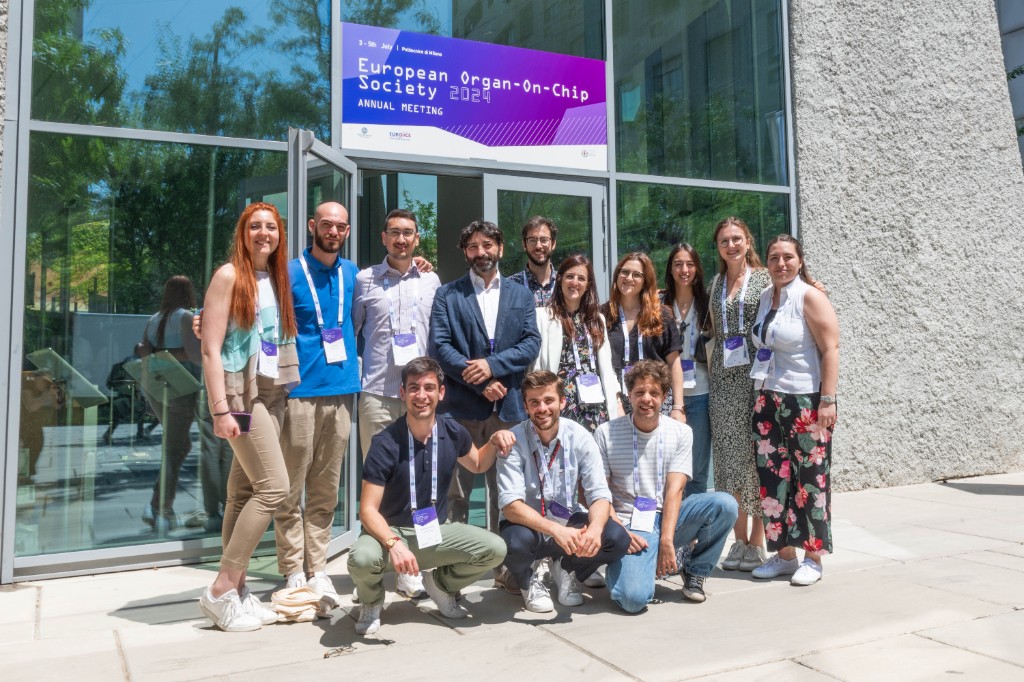
EUROoCS Annual Meeting 2024, Politecnico di Milano
Lab Highlights
A curated selection of peer-reviewed results, core platforms, and leadership roles.
Featured Publications
Selected peer-reviewed papers showcasing key lab contributions.
- VWF deficiency impairs angiogenesis via Angpt-2Blood (2026)
- Compartmentalized Joint-on-Chip modelAdvanced Science (2025)
- Gut-on-a-chip with human faecal samples + peristalsisNature Biomedical Engineering (2025)
Core Capabilities
From microfluidic platforms to human-relevant models and technology transfer.
- Microfabrication & soft lithographyRapid iteration of microfluidic chips
- Human-relevant biological modelsDisease-focused models built on patient-derived / human systems
- IP & technology transfer7 patents filed, 3 transferred (licensing/translation)
Leadership & Awards
Leadership roles and translational impact across the European OoC/MPS ecosystem.
- Marco RasponiChair, EUROoCS
- Paola OcchettaVice President (Regulatory Adoption & Partnerships), IAMPS
- BiomimXPolitecnico di Milano spin-off (2017) — organs-on-chip platforms
Research Topics
Explore our main research focus areas and ongoing projects
Latest News
Stay updated with our latest achievements and upcoming events
Vascularized Colorectal Cancer-on-Chip Published in Advanced Materials Technologies
A new MiMic Lab study, published open access in Advanced Materials Technologies, introduces a closed U-shaped microfluidic platform that overcomes a long-standing trade-off in tumour-on-chip models: achieving reproducible positioning and size control of a single tumour spheroid while vascularizing its entire surface symmetrically. The device traps one pre-formed colorectal cancer spheroid at a defined position, uniformly embedded in a fibrin matrix populated with GFP-labelled endothelial cells, enabling volumetric tumour–endothelial interactions and longitudinal imaging of the same construct over time. The work shows that tumour spheroids release a measurable pro-angiogenic secretory profile, and that VEGF gradients drive multicellular sprouting from endothelial monolayers. The crosstalk proved to be bidirectional. In tumour–vascular co-cultures the endothelium underwent hyperbranched remodeling, with higher junction density, branching and total vessel length than endothelial-only controls, while extracellular VEGF dropped markedly — consistent with endothelial binding and uptake of the ligand. Reciprocally, the vascularized tumours developed surface protrusions and anisotropic growth, lost epithelial junction organization and upregulated mesenchymal-associated markers, hallmarks of early invasion. The platform offers a tractable, quantitative framework for studying the earliest steps of tumour–vascular remodeling. The study is first-authored by PhD student Giacomo Cretti, with Dr. Mattia Ballerini and Dr. Alberto Mantegazza, and was coordinated by Prof. Paola Occhetta and Prof. Marco Rasponi.
MiMic Lab Shines with Three Awards at EUROoCS 2026 in Braga
A large MiMic Lab delegation took part in the EUROoCS Annual Meeting 2026, held June 22–24 at the Altice Forum in Braga, Portugal, and hosted by the International Iberian Nanotechnology Laboratory (INL). As the flagship event of the European Organ-on-Chip Society — chaired by our PI Prof. Marco Rasponi — the meeting gathered the international organ-on-chip and microphysiological systems community for two and a half days of plenary and keynote lectures, scientific sessions, and poster presentations spanning disease and multi-organ models, biofabrication, PK/PD modelling, standardization and toxicity. The week was a triumph for the group, which brought home three awards. PhD student Sonia Peddio received the 3rd Best Oral Award among Young Investigators, while PhD student Viola Antonello won the Poster Presentation Award. Our collaborator Stefano Piazza was honoured with the Best Oral Award among Senior Investigators, presenting the PHOENIX project. Dr. Mattia Ballerini and Dr. Alberto Mantegazza delivered talks, and Prof. Paola Occhetta joined the young investigators' round table, while Prof. Marco Rasponi chaired the society meeting and closed the conference. The strong MiMic Lab presence reaffirmed the group's central role in the European MPS landscape.
MiMic Lab at the MPS World Summit 2026 in Washington, DC
MiMic Lab joined the international MPS community at the MPS World Summit 2026, held May 26–29 at the Walter E. Washington Convention Center in Washington, DC — the premier global forum for Microphysiological Systems. Our PI Prof. Paola Occhetta delivered a talk, while Dr. Mattia Ballerini and Dr. Alberto Mantegazza presented posters showcasing the lab's mechanically active organ-on-chip models. The summit brought together researchers, industry innovators, and regulatory experts advancing organ-on-chip technologies for drug development, disease modeling, and regulatory science.
Get in Touch
Interested in learning more about what we do, collaborating with us, or joining our team?
Contact Us